If you work in a factory, a lab, a warehouse, or anywhere that uses chemicals, you have probably walked past an eye wash station without giving it much thought. Most people do. It sits there on the wall or near a workbench, and nobody pays attention to it until the day something goes wrong. And when that day comes, it becomes the single most important piece of equipment in the building.
Chemical splashes, dust particles, metal shavings, or even cleaning products can cause serious damage to your eyes within seconds. The first 10 to 15 seconds after exposure are the most critical. If you can flush your eyes with clean water during that window, you stand a much better chance of avoiding permanent injury. That is exactly what eye wash stations are designed for, and that is why they should never be treated as an afterthought.
What Are They and How Do They Work?
In simple terms, an eye wash station is a device that delivers a gentle flow of water to your eyes so you can rinse out harmful substances. Some units are wall-mounted with a small basin and two nozzles pointed upward. Others are portable bottles filled with saline or purified water that you can carry to different work areas. There are even combination units that include both an eye wash and a full body shower for larger chemical spills.
The basic idea is the same across all types. You lean forward, press a lever or squeeze a bottle, and water flows over your open eyes. The stream should be gentle enough not to cause extra harm but strong enough to wash away whatever got in there. Most plumbed units are set up so the water activates with one hand, leaving your other hand free to hold your eyelids open.
A common question people ask is whether tap water is good enough. For most workplace setups, yes, tap water works fine as long as the unit is properly maintained. Portable stations often use a buffered saline solution, which is a bit gentler on the eyes and has a longer shelf life. Either way, the point is to flush the irritant out as fast as possible.
Where Should You Put One?
Placement matters more than most people realise. South African health and safety regulations say that if your workplace uses hazardous substances, you need to provide accessible eye washing facilities. But “accessible” has a specific meaning here. The general rule is that a worker should be able to reach the station within 10 seconds of being exposed to a hazard. That usually translates to about 16 to 17 metres from any point where chemicals are handled.
Think about the layout of your workspace. If you have a mixing area on one side and the nearest station is around a corner, down a hallway, and behind a door, that is too far. The path to the unit should be clear of obstacles, well-lit, and on the same level as the work area. No stairs, no locked doors, no cluttered walkways.
It is common for businesses to put a single unit near the main entrance and call it a day. That might tick a box on a checklist, but it does not actually protect workers who are 50 metres away in a back room. You need to map out where chemicals are stored and used, and place stations accordingly.
Types You Should Know About
Plumbed Wall-Mounted Units
These are the most common in larger facilities. They connect to your building’s water supply and provide a continuous flow of water. The advantage here is that you never run out of water mid-flush. You press the paddle or lever, and clean water flows until you turn it off. The downside is that they need plumbing, which means installation costs and a fixed location.
Portable Squeeze Bottles
These are small, self-contained units that you can place anywhere. They are filled with saline or sterile water and have a nozzle designed to fit over the eye. They are great for areas where plumbing is not practical, like outdoor work sites, delivery trucks, or temporary setups. The trade-off is that they hold a limited amount of fluid and need to be replaced or refilled regularly.
Gravity-Fed Stations
These sit on a stand or mount and use gravity to push water down through the nozzles. They hold more fluid than squeeze bottles but do not need plumbing. You will see these in workshops, garages, and smaller operations. They work well, but you need to keep an eye on the water level and replace the solution before it expires.
Combination Shower and Eye Wash Units
For workplaces that handle large volumes of hazardous liquids, a combination unit that includes a full body drench shower along with eye washing nozzles makes sense. These are typically ceiling-mounted or freestanding and connect to the water supply. They are common in chemical plants, laboratories, and industrial kitchens.
Maintenance Is Not Optional
Here is where a lot of workplaces fall short. You can install the best equipment money can buy, but if nobody checks it for six months, it might not work when you actually need it. Plumbed units should be flushed weekly. This is not just to test whether water comes out. Stagnant water sitting in the pipes can grow bacteria, and spraying contaminated water into an already injured eye is a recipe for infection.
Weekly flushing clears out the old water and lets you check the flow pattern. Both nozzles should produce equal streams that cross at the right height. If one side is weaker than the other, there could be a blockage or a valve issue.
For portable units, check the expiry dates on the solution. Most saline bottles last about two years, but once opened or exposed to heat, that shelf life drops. Keep a log of when bottles were placed, and set reminders to swap them out.
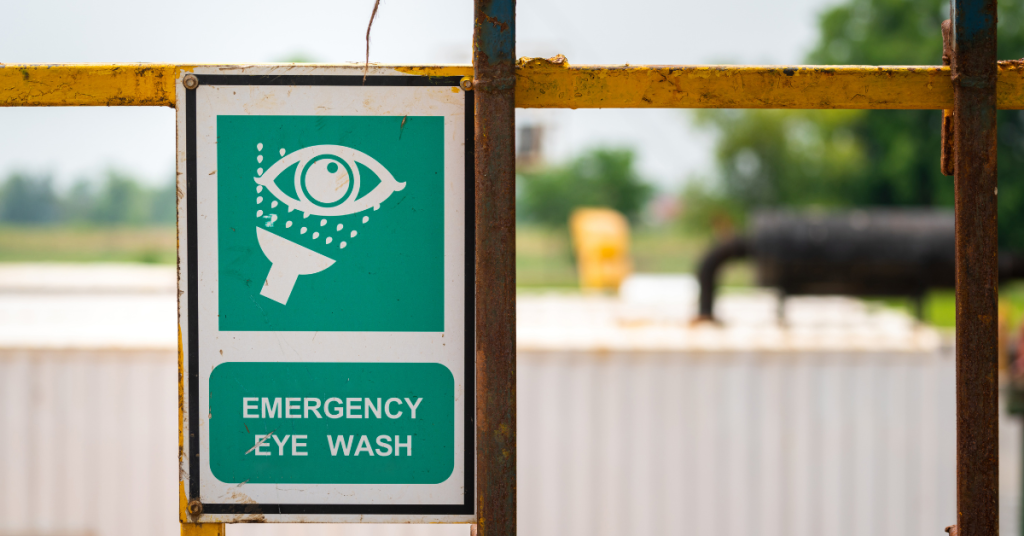
Signage is another thing people overlook. The station should be clearly marked with a visible sign, even from a distance. If someone has just been splashed in the face, they are not going to be reading small print. Bright green signs with a clear symbol are the standard, and they should be visible from every angle that a worker might approach.
Training Your Team
Having the right equipment is only half the battle. If your team does not know how to use it, the equipment is almost useless. Every new employee should be shown where the stations are during their first day. Run through the steps: how to activate the unit, how to hold your eyes open, how long to flush (the standard recommendation is at least 15 minutes for chemical exposure), and what to do after flushing.
It sounds simple, and it is. But in a panic, people forget simple things. Regular drills, even once or twice a year, keep the process fresh in everyone’s mind. You do not need to make it a big production. A five-minute walkthrough during a safety meeting is enough.
One thing that often gets missed in training is the instruction to remove contact lenses before flushing. Contact lenses can trap chemicals against the surface of the eye, making the injury worse. If a worker wears contacts, they should know to pop them out as quickly as possible before starting the flush.
Picking the Right Setup for Your Workplace
There is no one-size-fits-all answer here. The right setup depends on what kind of hazards your workers face, the layout of your facility, and your budget. If you are running a large operation with multiple chemical handling areas, plumbed wall-mounted units at each station make the most sense. If you have a small workshop with occasional exposure risks, a couple of portable bottles might be enough.
The important thing is to do a proper risk assessment first. Walk through your facility, identify every spot where someone could get something in their eyes, and plan your placement from there. Talk to a safety supplier who can look at your setup and suggest the right combination of equipment.
Do not forget about outdoor workers either. Construction sites, farms, and roadside operations all have exposure risks from dust, cement, fertilisers, and fuel. Portable units in a toolbox or mounted on a vehicle can make a big difference in those situations.