Most people who pass through an airport focus on what is happening inside the terminal. The check-in queues, the boarding gates, the coffee shops. What happens outside on the apron, on the runway taxiways, and around the aircraft itself is largely invisible to passengers, but it is where a significant portion of airport work actually takes place.
Ground operations is one of the less talked about sides of the aviation industry, but it is one of the most active. Every flight that departs on time does so because a team of ground staff did their jobs correctly in the window between the aircraft arriving and leaving again. Understanding what that work involves, and what it takes to get into it, opens up a career path that a lot of people overlook.
What Ground Handling Actually Covers
Ground handling is the broad term for all the services provided to an aircraft while it is on the ground between flights. It covers a wide range of functions that need to happen in a specific sequence and within tight time constraints.
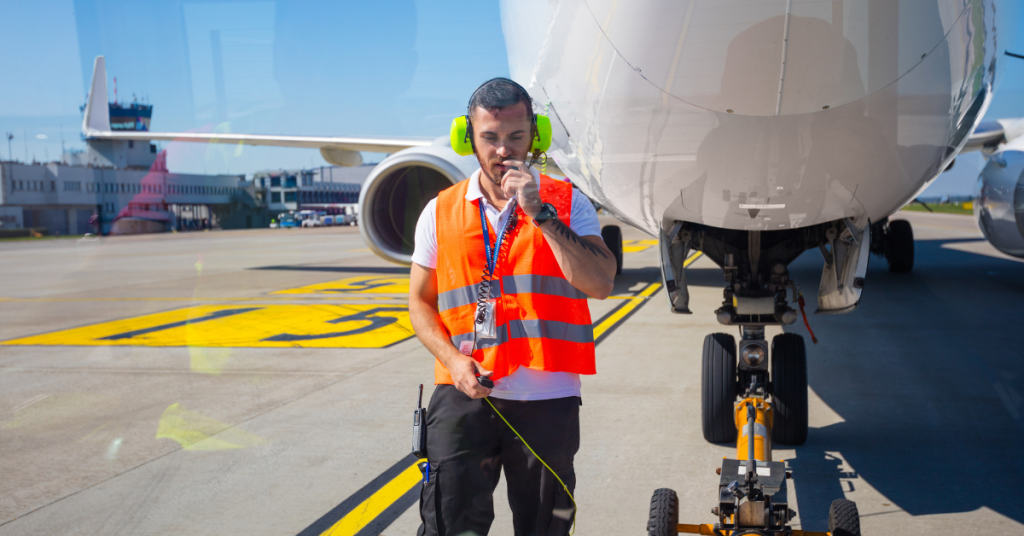
Ramp services involve the physical handling of the aircraft on the apron. This includes marshalling the aircraft into its parking position, connecting ground power, operating airstairs or jet bridges, loading and offloading baggage and cargo, and positioning the pushback tug to move the aircraft back from the gate before departure. All of this happens close to a live aircraft, which means training and safety awareness are not optional.
Baggage handling covers the sorting, loading, and offloading of passenger luggage and freight. Weight and balance calculations are part of this function because how cargo and baggage are distributed across the aircraft affects its handling in the air. Getting this wrong has serious consequences, which is why trained staff follow strict procedures.
Passenger services on the ground include check-in, boarding gate management, dealing with passengers who have missed connections, and handling irregular operations when flights are delayed or cancelled. This side of ground handling requires strong people skills on top of technical knowledge.
Aircraft cleaning and cabin preparation between flights is another ground handling function, making sure the aircraft is ready for the next set of passengers within the scheduled turnaround time.
Fuel coordination, catering loading, and technical support liaison are also part of the broader ground operations picture, though some of these overlap with other specialist departments depending on how a specific airline or handling company structures its teams.
Why Training Matters Before You Apply
The aviation industry is heavily regulated. Safety standards set by the International Air Transport Association, the International Civil Aviation Organisation, and national aviation authorities like the South African Civil Aviation Authority all apply to ground operations. Employers in this space need staff who understand those standards and can apply them from day one.
Completing an airport handling course before applying for ground operations positions gives you a real advantage. Most ground handling companies provide on-the-job training once you are hired, but arriving with prior knowledge of safety protocols, aviation terminology, and the structure of ground operations tells an employer that you are already familiar with the environment. That reduces the amount of time and money they need to invest in bringing you up to speed, which matters when they are choosing between candidates.
A ground handling course that is well-structured will cover the key areas: ramp safety and hazard awareness, dangerous goods awareness, weight and balance basics, passenger handling, and the regulatory framework that governs commercial aviation at ground level. Practical exposure to real airport environments is a bonus, though not all courses can offer that.
The Range of Roles Available
One of the reasons ground operations is worth considering as a career path is the range of roles within it. You are not locked into one type of work.
Ramp agents work directly on the apron with aircraft, baggage, and equipment. It is physically demanding and requires strong safety awareness, but it is also one of the more hands-on roles in aviation for people who prefer to be active rather than desk-based.
Passenger service agents work inside the terminal at check-in counters and boarding gates. This role requires good communication skills and the ability to stay calm when passengers are stressed or situations become complicated. Delayed flights, overbooking situations, and passengers with special needs all come through this function regularly.
Load controllers and dispatchers work on the documentation and data side of ground operations. They manage weight and balance calculations, prepare load sheets, and coordinate with flight crews. This role requires more technical knowledge and attention to detail.
Supervisory and management positions exist within ground handling operations for staff who build experience and want to take on more responsibility. Team leaders, shift supervisors, and station managers are all progression points within larger handling companies.
Getting Started in South Africa
South Africa has three major international airports managed by ACSA: OR Tambo in Johannesburg, Cape Town International, and King Shaka in Durban. There are also several regional airports at which ground handling operations run. Ground handling companies operate at these facilities under contracts with airlines, and they employ staff across all the functions described above.
Entry-level positions in ground handling typically require a matric certificate as a minimum. Beyond that, relevant training, a clean record, and the right personal qualities are what employers look for. The ability to work shifts, including nights, weekends, and public holidays, is a practical requirement because airports operate around the clock.
Completing aircraft ground handling training before applying puts your application in a stronger position from the start. It shows that you understand what you are applying for and that you have already invested in preparing yourself for the role. That matters to employers who are processing large numbers of applications for a limited number of positions.
Language skills are an asset in this environment. English is the standard language of aviation communication, and being comfortable in it both verbally and in writing is expected. Additional languages are a bonus in passenger-facing roles where you may be dealing with international travellers who are not comfortable in English.
What the Work Environment Is Like
Airport ground operations is a fast-paced, weather-exposed, shift-based environment. If you are coming from a background where you have worked regular office hours in a climate-controlled setting, the adjustment is significant.
Ramp work happens outdoors in all conditions. South Africa’s weather is generally manageable, but working on an exposed apron in wind and rain while coordinating a turnaround under time pressure is a different experience from what most other jobs involve. The physical demands are real and the safety stakes are high.
The time pressure is constant. Turnaround windows for short-haul aircraft can be as tight as twenty-five to thirty minutes. In that window the arriving passengers and baggage need to be offloaded, the cabin cleaned, the departing baggage and cargo loaded, catering restocked, and the aircraft prepared for pushback. Every function needs to happen in sequence and on time. When something goes wrong at one point in the process it affects everything that follows.
That pressure is also what a lot of people in ground operations say they enjoy about it. There is a clear result at the end of every shift. Either the flights went on time or they did not. The work is measurable and immediate in a way that more abstract roles are not.
Building a Long-Term Path in Aviation
Ground handling is a legitimate starting point for a broader aviation career. Many people in airline management, airport operations leadership, and aviation training started on the ramp or at a check-in counter. The operational knowledge you build in ground handling is practical and transferable across the industry.
Completing an airport ground handling course and then gaining hands-on experience in a ground operations role gives you a foundation that can support movement into other parts of the aviation sector over time. Some people use it as a stepping stone toward cabin crew roles. Others move into flight operations support, dispatch, or load control. Some stay in ground operations and build into management.
A ground operations course that is delivered by people with actual industry experience and that covers the content airlines and handling companies expect gives you the most useful preparation. Check what the curriculum covers, whether the instructors have relevant backgrounds, and whether the qualification is recognised by employers in the sector before you commit.
The aviation industry rewards people who are reliable, safety-conscious, and good under pressure. Those qualities matter more than any specific educational background, and they can be demonstrated in the application and interview process by candidates who have done the right preparation.